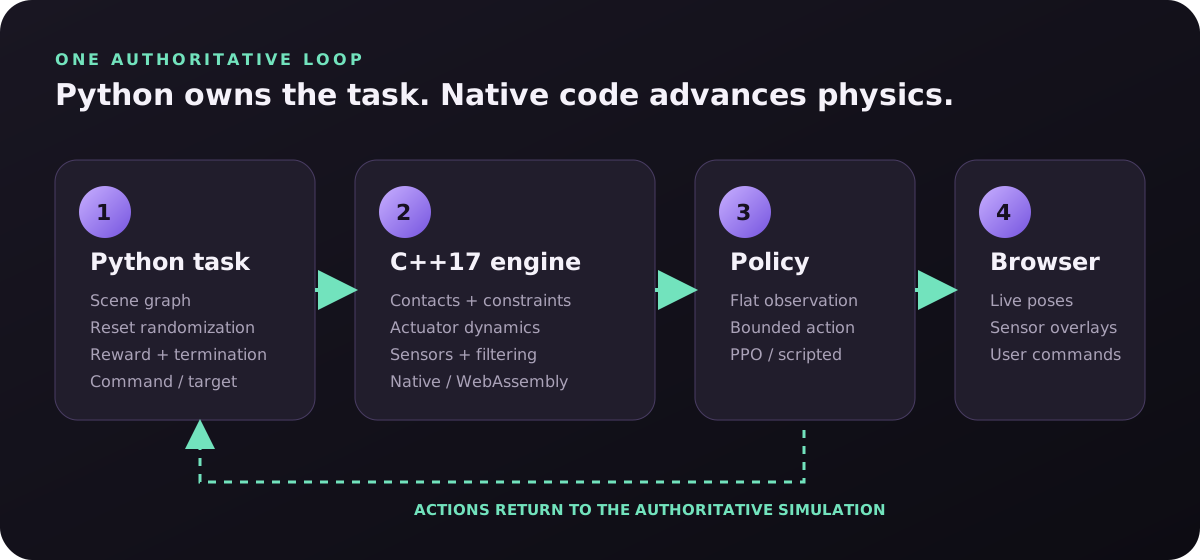
Scene, runtime, environment
Scene
An immutable description of bodies, joints, materials, sensors, actuators, sites, terrain, cameras, and render hints.
Runtime
CodeSceneEnv compiles the scene into native state and advances contacts, constraints, actuators, and sensors.
Task environment
lavendersim.env owns randomization, policy observations, reward, success, failure, and episode timing.
Three clocks to keep straight
| Clock | Typical value | What happens |
|---|---|---|
| Native integration | Internal substeps | Contacts and joint constraints are resolved. |
| Control step | 1 / 60 s | The policy supplies one action and receives one observation. |
| Episode horizon | 3 s | The task returns truncated=True when time runs out. |
A 60 Hz, three-second rollout therefore contains 180 policy decisions. Sensor sample intervals and delays are measured against simulation time, not wall-clock browser refreshes.
Observation → policy → action
observation, info = env.reset(seed=7)

action = policy(observation)        # shape == env.action_space.shape
observation, reward, terminated, truncated, info = env.step(action)
Policy observations are flat float32 arrays for simple batching. Rich native telemetry remains available under env.sim for debugging and visualization. Reward code may use privileged state, but policy inputs should contain only the signals the deployed controller is meant to observe.
| Signal | Policy input? | Reason |
|---|---|---|
| IMU, joint angle, joint velocity | Usually | Physically measurable proprioception. |
| Command direction and speed | Yes | The behavior is conditional on the requested motion. |
| Exact world pose | Often no | Useful for reward/debugging, but may not exist on a real robot. |
| Contact force or tactile grid | Task dependent | Critical for grasping and insertion, unnecessary for CartPole. |
The sensor pipeline is part of the environment
config = SensorConfig(
    sample_interval=1 / 120,
    cutoff_hz=20,
    noise=0.005,
    delay=0.016,
)
scene.imu("torso.imu", torso, sensor=config)
Noise and latency are deterministic for a reset seed, which keeps debugging and snapshot replay useful while still exposing the policy to realistic imperfections.
Contacts, friction, and settling
Contact behavior comes from geometry and material properties. Static friction resists the start of sliding; dynamic friction acts while sliding; rolling and torsional friction slow spheres and spinning contacts; restitution controls bounce.
inside = distance_to_goal < 0.08
stationary = ball_speed < 0.04
success = dwell.update(inside and stationary)
Snapshots make counterfactuals cheap
branch = env.snapshot()
next_a = env.step(action_a)

env.restore(branch)
next_b = env.step(action_b)
A snapshot includes bodies, joints, controls, actuator activation, tendon state, sensor filters and delays, simulation time, RNG state, and a scene fingerprint. Restoring it answers “what would have happened under another action?” without rebuilding the world.
Coordinates and units
| Quantity | Convention |
|---|---|
| Position / length | metres |
| Time | seconds |
| Mass | kilograms |
| Angles | radians |
| Force / torque | newtons / newton-metres |
| World axes | +Y up; planar tasks commonly use X/Z |
| Quaternion | (x, y, z, w) |